Taming the "Verbatim" Chaos
Designing Production-Ready NLP and Multi-Agent Pipelines
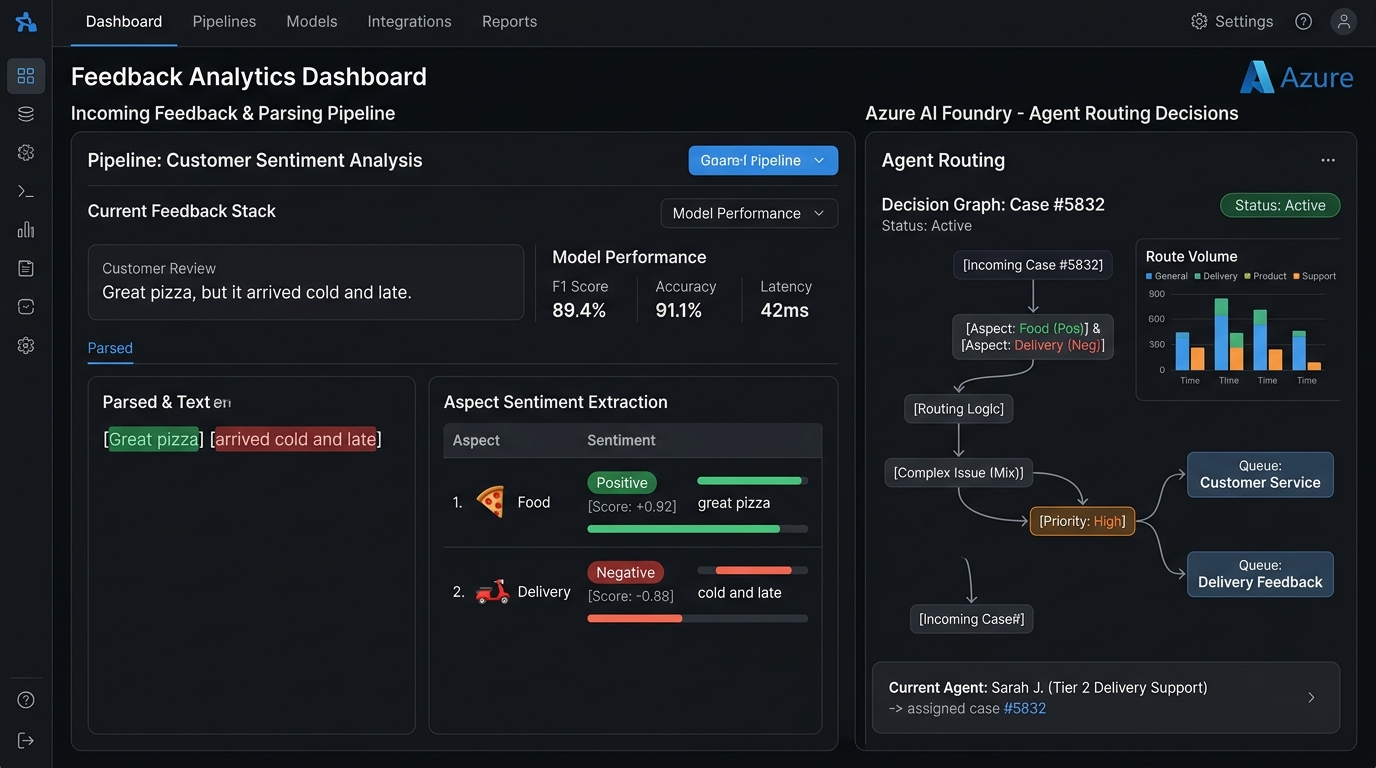
“Standard sentiment APIs fail on real text by collapsing nuance into mixed scores; production pipelines must decompose verbatims into aspect-level sentiment tuples mapped to routable business objectives.”
Unable to render slides in-page.
Download PDF Deck Directly ↓Session Overview & Thesis
Standard sentiment APIs fail on real text — collapsing a review like “great pizza, but it arrived cold and late” into a useless “mixed” score. Instead, this production pipeline decomposes each verbatim into aspect-level sentiment tuples, maps them to owned business objectives, and enriches them with real-world context like weather and major events.
It walks through an end-to-end architecture on Azure (Microsoft Fabric for ingestion and cleaning, PostgreSQL with pgvector for storage, Azure AI Language for aspect-based sentiment, and Microsoft Foundry for the coordinated agent layer), then covers production concerns like evaluation, governance, cost, and disaster recovery. The through-line is a reframe: the goal isn’t “how positive is this text?” but “which objective is affected, in which direction, and what should happen next?”
Pipeline Architecture (Azure Stack)
- 01 Ingest & Clean (Microsoft Fabric): Medallion architecture (Bronze → Silver → Gold), OneLake ingestion, PII redaction, and deduplication.
- 02 Relational & Vector Store (PostgreSQL + pgvector): Structured aspect tuples, embeddings, master objective taxonomy, and immutable audit logs.
- 03 Semantic Intelligence (Azure AI Language): Aspect-based sentiment analysis (ABSA), target/opinion extraction, and few-shot objective mapping.
- 04 Agent Decision Swarm (Microsoft Foundry): Hierarchical orchestrator routing to specialized Extraction, Mapping, Enrichment, and Action agents.