From Collision to Clarity
Claude in Copilot Studio & Microsoft Foundry: The Rise of Agentic AI
“Effective agentic AI is not simply a model-selection exercise; business value depends on context engineering, orchestration, governed data access, task-appropriate models, explainability, and deliberate human control.”
Unable to render slides in-page.
Download PDF Deck Directly ↓Session Overview: Claim A-1047
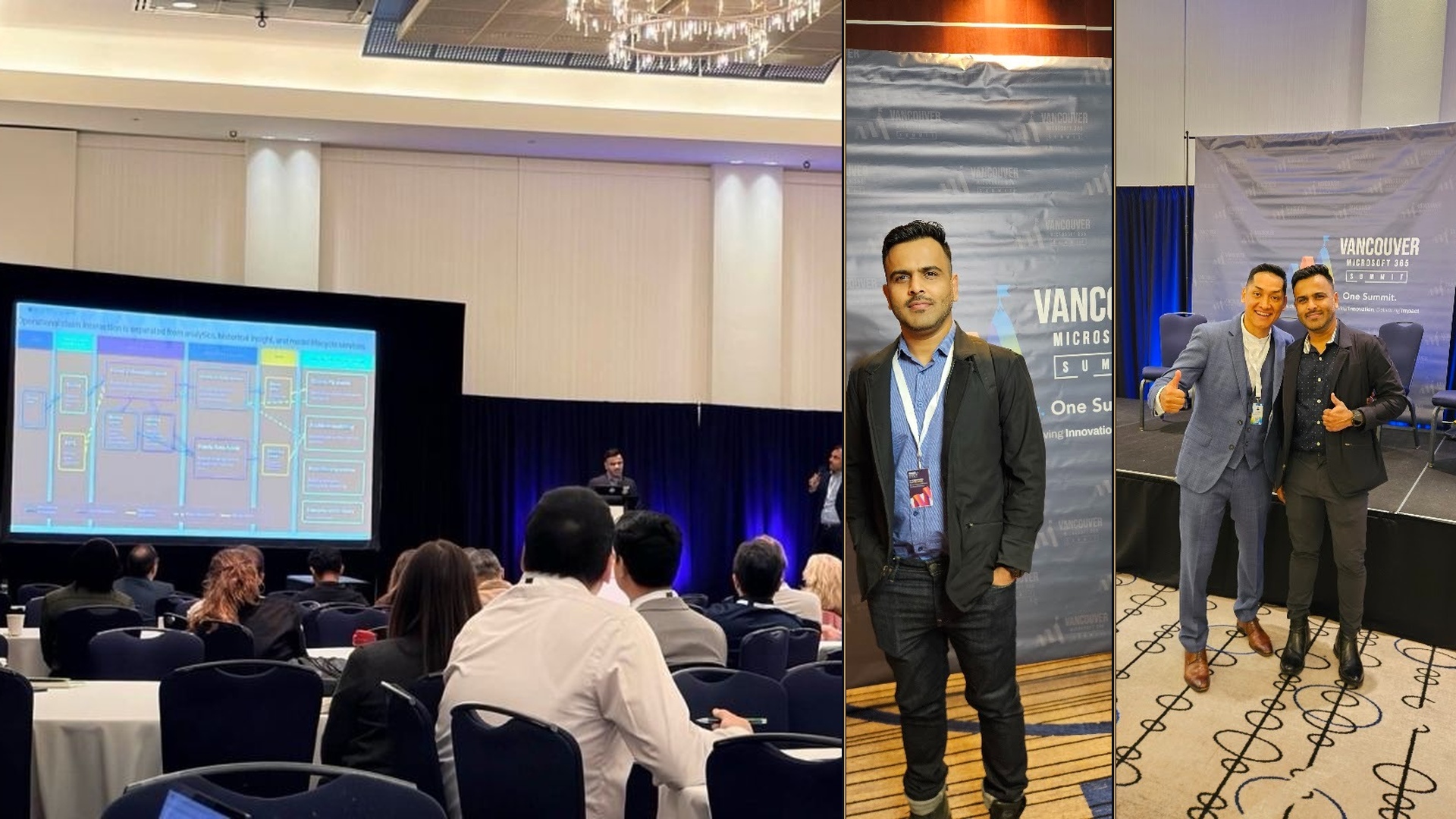
Presented at the Vancouver Microsoft 365 Summit on September 3, 2026 with co-speaker Mitul Tailor (Sr. Data Engineer, LVS), this session investigates how agentic AI can transform complex, document-heavy business processes. Read the LinkedIn post and event retrospective here. Using an auto-insurance claims scenario (Claim A-1047), the talk walks through initial intake, extraction, historical analysis, multi-modal reasoning, triage, human review, and action.
Auto-insurance claims typically arrive as an inconsistent collection of forms, photos, police reports, repair estimates, policy documents, and call notes. In Claim A-1047, the claim narrative describes a rear impact, while the submitted evidence primarily indicates front-left damage. The architecture demonstrates how an AI-assisted process flags this contradiction objectively, requests missing details, and routes the claim for human review without prematurely concluding fraud.
Core Architectural Pillars
- Extraction vs. Contextual Reasoning: Separates deterministic data extraction (reading forms, policy numbers, dates) from contextual multi-document reasoning (comparing damage photos to narratives, evaluating policy exclusions, generating structured hypotheses).
- Task-Appropriate Multi-Model Strategy:
- Lightweight Models: Classification and fast intent routing.
- Extraction Services: Form fields, OCR, document layout parsing.
- Claude via Microsoft Foundry: Deep multimodal evidence synthesis, long-context document reasoning, and contradiction detection.
- Business Rules & ML: Deterministic threshold checks and historical fraud risk scoring.
- Evidence-Backed Explainability: “A recommendation is not enough. Show the evidence.” Every triage recommendation includes confidence intervals, supporting evidence citations, contradictory points, missing fields, and suggested next steps.
- Architectural Human-in-the-Loop Boundaries:
- Automate: Document classification, completeness checks, historical retrieval, routine summaries.
- Recommend: Triage tier, potential inconsistencies, specialist routing, evidence review flags.
- Retain Human Authority: Coverage denial, liability determination, material settlement sign-off, fraud referral.
Logical Reference Architecture
- Interaction & Orchestration: Microsoft Copilot Studio (Parent orchestrator, Reader agent, History agent, tool routing via Microsoft Teams).
- Reasoning & Synthesis: Microsoft Foundry deploying Claude for bounded deep reasoning tasks.
- Governed Analytical Data: Microsoft Fabric & Fabric Data Agent providing semantic historical claims access.
- Systems of Record & MLOps: Authoritative enterprise claims databases, Azure ML prediction endpoints, and immutable audit logs.