AI Agents that Ship
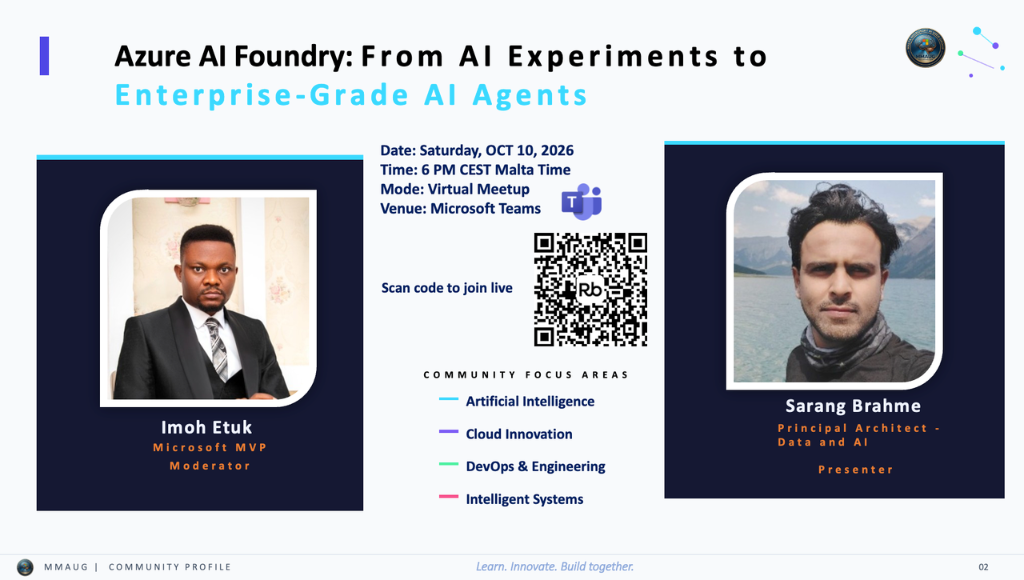
Microsoft Foundry - From AI Experiments to Enterprise-Grade AI Agents
“Most agents never fail on the model; they fail on everything around it, and Microsoft Foundry gives you the knowledge, identity, evaluation and operations to take them from playground to production.”
Unable to render slides in-page.
Download PDF Deck Directly ↓Session Overview
Delivered on October 10, 2026 for the Malta Microsoft AI User Group (MMAUG) virtual meetup, hosted by Microsoft MVP Imoh Etuk.
📺 Watch Full Recording: The complete session recording is available on YouTube at youtube.com/watch?v=FzamICZphPA.
Most teams discover that building a functional prototype in a playground takes fifteen minutes, but taking that agent to production takes months. Gartner forecasts that over 40% of agentic AI projects will be cancelled by 2027 due to escalating costs, unclear business value, and inadequate risk controls. Notice what is missing from that list: “the model wasn’t smart enough.” All three failure modes stem from platform and architecture decisions.
“Production is a property of the system around the model, not of the model.”
This session and accompanying hands-on lab explore Microsoft Foundry as the end-to-end foundation for building, deploying, evaluating, and operating resilient agent fleets in enterprise environments.
Downloads & Companion Resources
Presentation Deck
Complete 32-slide presentation deck covering the five production pillars, failure modes, Foundry IQ, Toolboxes, LLMOps pipelines, and fleet governance.
Download Slides (PDF)Hands-on Lab Manual
26-page production runbook guiding you through all seven modules: from prototype failure to multi-agent deployment with CI/CD gates.
Download Lab Guide (PDF)The Five Production Pillars
To move from playground experiments to enterprise systems, teams must address five distinct architectural pillars:
| Pillar | Focus | Foundry Capabilities |
|---|---|---|
| 1. Ground | Shared, cited, permission-aware knowledge | Foundry IQ: Unified knowledge bases over Blob, SharePoint & SQL; agentic multi-step retrieval via MCP endpoints |
| 2. Act | Sandboxed runtime and governed tools | Foundry Agent Service & Toolboxes: Managed execution sandboxes, versioned MCP tool endpoints, Model Router |
| 3. Trust | Evaluated, guarded, red-teamed | Evaluations & Guardrails: Rubric, ASSERT test suites, prompt-shield and PII guardrails, automated red-teaming |
| 4. Govern | Identity, inventory, cost, control | Microsoft Entra Agent ID & Agent 365: Standalone agent service principals, least-privilege scoping, fleet inventory |
| 5. Operate | LLMOps to ship, AIOps to run | CI/CD Gating & Application Insights: GitHub Actions eval gates, OpenTelemetry tracing, quality canary probes |
Live Demo: Build, Ship, Operate in Six Acts
- Act 1: The Experiment (2 min) — Playground prompt agent with a policy PDF attached. When asked about hail damage on Policy C-123, it confidently answers incorrectly based on superseded policy wording, with no citations, running under personal user credentials.
- Act 2: Foundry IQ (5 min) — Grounding with
claims-kbover policy wordings, procedures, and claims data. Demonstrates minimal vs. medium reasoning effort and permission-aware retrieval over MCP. - Act 3: Productionize (3 min) — Unifying knowledge and claims APIs behind a secure Foundry Toolbox (
claims-tools). Deploying a hosted agent with dedicated Microsoft Entra identity and Content Safety guardrails. - Act 4: LLMOps — Ship a Change (4 min) — Opening a PR with an instruction change. The GitHub Actions pipeline runs deterministic evaluation checks (
evals/gate.py), catches an unauthorized $31,000 claim approval regression, and blocks deployment. - Act 5: AIOps — Operate It (4 min) — Service-level observability with OpenTelemetry and Application Insights. Continuous quality canaries detect silent knowledge drift, fire an alert, isolate the offending span in traces, and trigger a Git rollback.
- Act 6: Govern — Scale the Workforce (3 min) — Reusing the knowledge base and Toolboxes for a nightly intake routine and a Microsoft Teams adjuster assistant, monitored in Microsoft Entra and Agent 365.
The Hands-on Lab: 7 Practical Modules
The companion 26-page runbook walks through building this architecture in your own Azure subscription around the Contoso Mutual synthetic insurance scenario:
- Module 1: Prepare the Sample Data — Configuring Azure Storage containers with 2026 wording (Form AUTO-26 with Endorsement E-7) vs. 2024 wording (AUTO-24 excluding outdoor hail).
- Module 2: Build a Prototype Agent and Find Its Limits — Reproducing silent prototype failures in the portal playground.
- Module 3: Ground Agents with a Foundry IQ Knowledge Base — Connecting Azure AI Search, setting retrieval instructions, and testing MCP endpoints with
kb_query.py. - Module 4: Make the Agent Production-Ready — Writing the FastMCP claims server, provisioning Foundry Toolboxes, scaffolding with
azd ai agent, and attaching guardrails. - Module 5: LLMOps: Test and Gate Every Change — Setting up Entra workload identities, GitHub Actions CI (
agent-ci.yml), and automated PR evaluation gates. - Module 6: AIOps: Monitor, Alert and Roll Back — Running
canary.py, configuring Log Search alerts in Application Insights, simulating an incident, and executing a rollback from Git. - Module 7: Scale to a Multi-Agent Workforce and Govern It — Creating scheduled intake routines, publishing the adjuster bot to Microsoft Teams, and monitoring fleet telemetry in Agent 365.
Three Things to Take into Monday
- Separate the knowledge from the agent: Maintain one managed Foundry IQ knowledge base consumed by multiple agents, with permissions enforced at retrieval time.
- Production is a checklist, not a feeling: Require identity, guardrails, an automated evaluation gate, SLO alerts, and a tested rollback plan before the first user logs on.
- Build production on GA, pilot on preview: Architect production systems on generally available services, while exploring preview capabilities behind clean interfaces.
Speaker & Organization Links
- Speaker: Sarang Brahme — LinkedIn Profile
- Organized by: Malta Microsoft AI User Group
- Moderator: Imoh Etuk (Microsoft MVP, Malta Microsoft AI User Group)