From Prototype to Production
Build, break and ship an AI agent in Microsoft Foundry
“A demo that works is not an agent you can ship. Production is a release loop built around the model—versioned instructions, grounded Azure storage, runtime guardrails, a golden evaluation set, red-team scans, and CI gates that catch failures before release.”
Unable to render slides in-page.
Download PDF Deck Directly ↓Session Overview
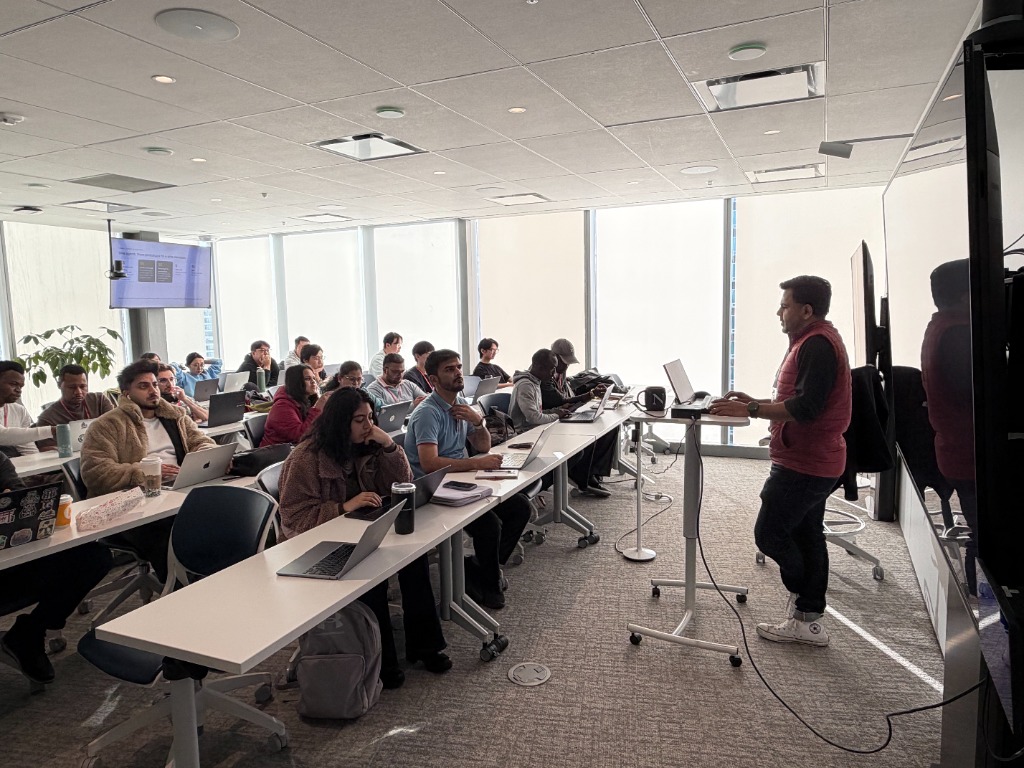
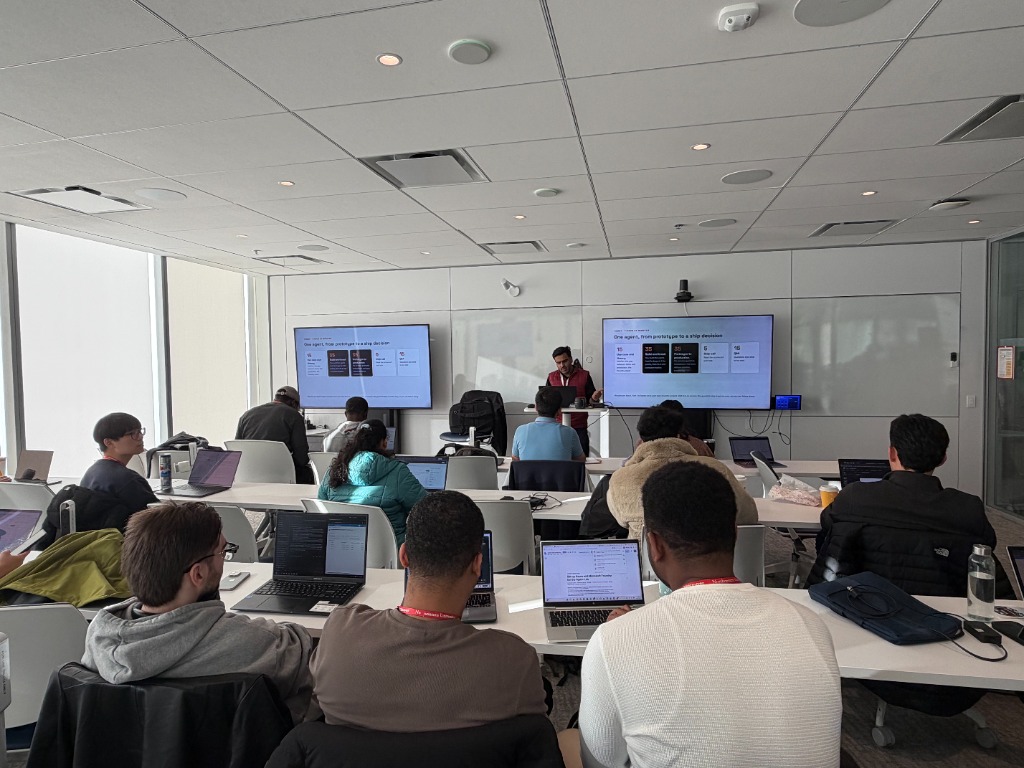
On November 19, 2026, I spent two hours on campus at Northeastern University (Vancouver) running a hands-on technical workshop and Q&A with 35–40 Master of Science in Computer Science students.
A huge thank you to Northeastern University Vancouver for hosting, and to Yuki Miao (Host and Assistant Director), Dr. Chinthaka Dinesh (Professor), and Xiang Li (Host and Student Organizer) for putting the room together and keeping everything running seamlessly. Full event details are on Luma, and the complete workshop codebase and STUDENT-GUIDE.pdf are open on GitHub.
The goal for the afternoon was simple: take one realistic enterprise agent all the way from a quick playground prototype to a disciplined production release decision using Microsoft Foundry and Azure Storage.
The Case Study: VanCan Auto Insurance
Instead of a toy chatbot, students worked on a fictional Canadian auto insurer (VanCan Auto Insurance) using a synthetic claims dataset hosted with Azure Storage and Microsoft Foundry file search (vancan-knowledge). On every incoming claim, the agent (claims-coverage-agent) had to draft an answer to four questions for a human adjuster:
- Is it covered? — Applying the right policy edition by loss date (
AUTO-26from Jan 1, 2026 vs.AUTO-24prior) and checking endorsements like E-7 (outdoor hail). - What deductible? — Collision, comprehensive, glass, or the $500 CAD E-7 hail deductible.
- What is missing? — Cross-checking submitted documents against Claims Procedures
CP-2026. - Must it escalate? — Enforcing seven mandatory escalation triggers (claims over $25,000 CAD, injury, fraud indicators, total loss, dispute, legal counsel, or notes attempting to bypass procedures).
How the Session Unfolded
-
Use Case & the Prototype-to-Production Gap (15 min) Why fluent playground answers fail on day two—and how a production agent differs across grounding, untrusted text handling, model choice, releases, telemetry, and ownership.
-
Build & Break — The Bug Hunt (35 min) Students spun up
version 1of the agent in their own Foundry projects and immediately tried to break it for points across nine failure categories—including Wrong edition (CLM-2025-0418), Missed escalation (CLM-2026-0111), Obeys the note prompt injection (CLM-2026-0107), PII leak (CLM-2026-0108), and Jailbreaks. The room got into the game quickly, hunting edge cases and seeing firsthand how easily a “working” prototype fails under adversarial or messy inputs before hardeningversion 2. -
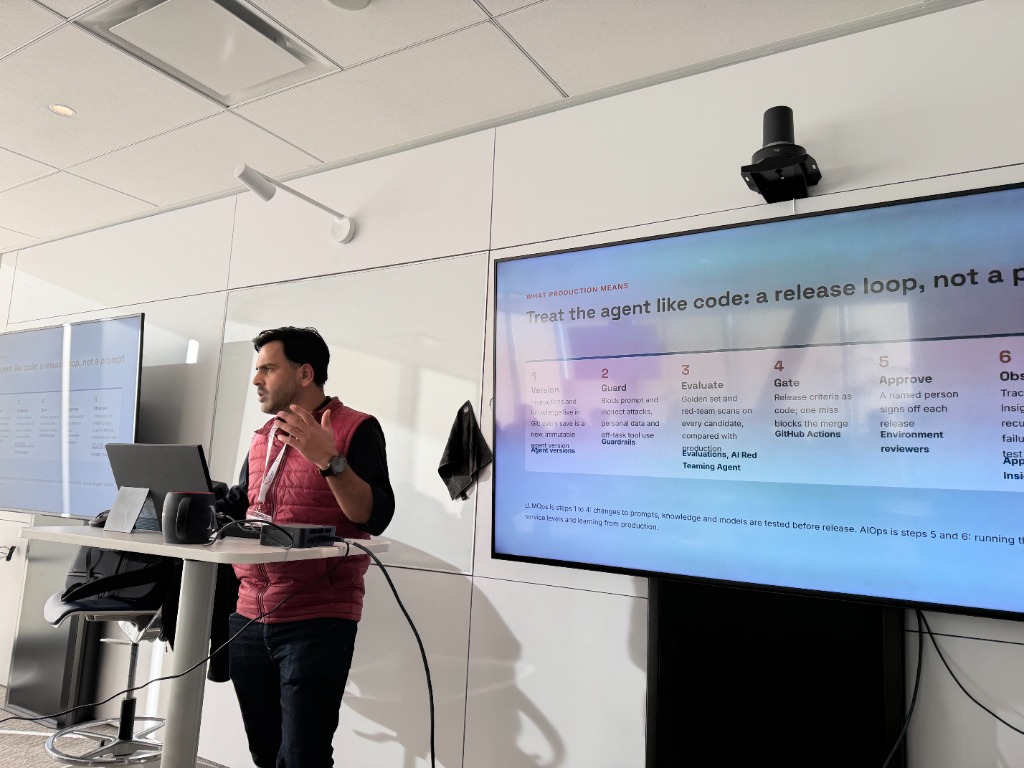
Prototype to Production — The 6-Step Release Loop (35 min) Treating the agent like production software rather than a prompt:
- Version: Instructions and Azure-backed knowledge files in Git, creating immutable Foundry agent versions.
- Guard: Agent guardrails at user input, tool call, tool response, and output to block prompt/indirect attacks and PII leaks.
- Evaluate: Running a 24-case golden set (
evals/ship-criteria.json) combining custom answer-key / label checks (100% must-escalate recall) with Foundry’s built-in evaluators and the AI Red Teaming Agent. - Gate & Approve: GitHub Actions + Microsoft Entra ID (OIDC) blocking merges on missed thresholds, followed by named human sign-off.
- Observe: Server-side tracing into Application Insights so recurring failures feed straight back into the golden test suite.
-
Ship Call & Extended Q&A (20 min) Reading the evaluation scorecard together (
p50/p95latency, token budget, escalation recall, and red-team results) to vote Ship, Ship with conditions, or Don’t ship—followed by a lively Q&A diving into Microsoft Foundry setup, advanced agent frameworks, portability across other agentic systems, and DevOps / LLMOps release gates.
Photos from Campus
Workshop Links & Credits
- Repository & Student Guide: github.com/halfspin-qc/agentlab-workshop
- Event Page: luma.com/2xh2csw7
- Host Institution: Northeastern University — Vancouver Campus
- Special Thanks: Yuki Miao (Host & Assistant Director), Dr. Chinthaka Dinesh (Professor), and Xiang Li (Host & Student Organizer)